<link rel="me" href="https://www.blogger.com/profile/07075050514837741360" /> <meta name='google-adsense-platform-account' content='ca-host-pub-1556223355139109'/> <meta name='google-adsense-platform-domain' content='blogspot.com'/> <!-- --><style type="text/css">@import url(https://www.blogger.com/static/v1/v-css/navbar/3334278262-classic.css); div.b-mobile {display:none;} </style> </head><body><script type="text/javascript"> function setAttributeOnload(object, attribute, val) { if(window.addEventListener) { window.addEventListener('load', function(){ object[attribute] = val; }, false); } else { window.attachEvent('onload', function(){ object[attribute] = val; }); } } </script> <div id="navbar-iframe-container"></div> <script type="text/javascript" src="https://apis.google.com/js/platform.js"></script> <script type="text/javascript"> gapi.load("gapi.iframes:gapi.iframes.style.bubble", function() { if (gapi.iframes && gapi.iframes.getContext) { gapi.iframes.getContext().openChild({ url: 'https://www.blogger.com/navbar/538546064539074062?origin\x3dhttp://franticindustries.blogspot.com', where: document.getElementById("navbar-iframe-container"), id: "navbar-iframe" }); } }); </script>
0 comments | Saturday, December 2, 2006

Notice: You are viewing a post on my old site. Click here to go to the new site.

CNET has recently launched atlarge, a community website which collects information on internet connectivity at airports around the world

The site has a pretty comprehensive database of both U.S. and international airports, and it's up to users to supply data on the available internet connectivity (wireless or wired), its quality and cost.

You can navigate the airports via a drop-down menu or you can use the search function. A tiny Google map is also included for every airport in the database. It's all very simple but also pretty usable, although the huge CNET ad is diverting the users' attention from the main content.

As far as available data goes, well, the site is new, so there is very little information at this point. Airports in cities like Vienna, Zagreb or Barcelona yield no results, and even in the USA I had to click a couple of times until I got any info; actually, the only city I've managed to find info on was New York. However, CNET will probably push it a little, and I don't doubt it will be swarming with information in a couple of months. Nice idea, well done, CNET.

Labels: , , ,


Read entire post! | Digg! | Reddit! | del.icio.us! | Stumble!

0 comments | Friday, December 1, 2006

Notice: You are viewing a post on my old site. Click here to go to the new site.

A friend pointed a relatively young interesting website to me, www.freemoviescinema.com. It collects free movies but categorizes them carefully, putting a lot of effort in choosing the best quality videos.

At this time there is only 139 movies on the site. However, (in contrast to Youtube and similar services, where you can find zillions of movies but don't know where to start) I'm interested in almost all of them.

The movies themselves are just (supposedly free of copyright) Google video or Youtube clips embedded in a nice GUI, but they are well categorized, with year of release, duration, plot, cast, a link to IMDB info and even a poster of the movie.

The news section of the site brings a couple of RSS feeds - nothing spectacular but nice enough.

As far as social interaction goes, you can rate the movies, and that's pretty much it. However, the site is more about the good editorial choice of the admin than about socializing.

The site itself is pretty ad-ridden, and even most of the ads are standard, unobtrusive Google ads, at some points it does become too much and pulls the viewers' attention from the content.

Final thoughts? Well, although I expected something more Web 2.0-ish, I must say that I'm not disappointed. The site works - it's just a nice little place to go and check out a good movie or two. Yes, there are a few ads too many, but the content is free, so I doubt anyone will complain.

Labels: , , , ,


Read entire post! | Digg! | Reddit! | del.icio.us! | Stumble!

0 comments | Thursday, November 30, 2006

Notice: You are viewing a post on my old site. Click here to go to the new site.

Ewidi is an interesting Web 2.0 service that has just been brought to my attention. It brings together the features of a search engine and an ad service, and enables users to connect and interact with each other using simple text messages

Ewidi basically consists of searching and publishing. You need to buy a used car in San Francisco, you either search for it, or browse tags/categories/locations for text messages corresponding with the subject. On the other hand, if you're an unemployed coder in need of work in Amsterdam, you'll post a message saying just that.

It is an internationally-oriented (the whole service is translated to 27 languages), service, and many users might find it odd that ads are not all in English. But why should they be? You can filter only the ones that you're interested in, and if someone needs to post information that will be of interest to anyone, no matter at which location' they're based, they'll probably post in English.

Ewidi also allows for creation of sub-domains, which correspond with tags/certain interest groups. Some of the ones that are available at the moment are film.ewidi.com, macedonia.ewidi.com, and osijek.ewidi.com (Osijek is a city in Croatia; it's no wonder they chose it because one of the authors of the service, Marko Kovač, is from Croatia.).

After you register, you are able to publish your own messages and to interact with other users. The registration doesn't even require an email, so it's really simple to try, but I personally like when at least an email is required to register for a service, because it keeps spammers at bay.

Unfortunately, currently by far the best way to use the service is by using search - the categories and tags aren't really well established yet. But, judging from the swarm of Spaniards which are currently overwhelming the service (the story about Ewidi has been published in the Spanish magazine El Mundo), the idea is working well in its current state. Looking forward to see how this one will develop.


Labels: , , , ,


Read entire post! | Digg! | Reddit! | del.icio.us! | Stumble!

0 comments | Wednesday, November 29, 2006

Notice: You are viewing a post on my old site. Click here to go to the new site.

Google is shutting down one of its services for a change, and - lo and behold - it's one of their rare services that's not free, Google Answers

At this time Google Answers is still operational, however according to the official Google blog, it's not receiving any new questions, and new answers will be accepted until the end of the year. The answers to old questions will stay online though.

Although it's weird to see Google shut down one of their services, it's not a big surprise - they've tried so many different things over the years that some of them were bound to ultimately fail.

Labels: , , , ,


Read entire post! | Digg! | Reddit! | del.icio.us! | Stumble!

0 comments | Tuesday, November 28, 2006

Notice: You are viewing a post on my old site. Click here to go to the new site.

Since it's an incredibly slow tech news day today, I'm going to go back to the stories I did over the years and try to count in which countries lawsuits have been filed and won against individuals for pirating music.


I know it's of little comfort to US citizens, but there are still some countries where people haven't been receiving lawsuits for a little Emule or Soulseek downloading. And by this I don't mean people who earn thousands or millions by selling pirated stuff - I mean users who don't do this for profit. However, the plague is spreading. Let's see which countries have been struck so far (feel free to comment and add to the list, I'm sure I missed some).

1. USA - the obvious one. It's basically RIAA's playground, as they can do their "john doe" lawsuits here without bullying other countries into changing their laws, and in the USA they've been happily pursuing their tactic of "lots of stick and an old withered carrot", arresting people left and right and advocating DRM-laden crappy formats in exchange. First wave of lawsuits were launched back in 2003 (263 people were sued), and to my knowledge this number is near 20.000 American individuals at this moment.
2. Germany - as far as I know, over 7000 German citizens have been sued for pirating music by the IFPI (International Federation of Phonographic Industry). As a result, these people mostly had to pay a fine of 2500 Euros.
3. United Kingdom - At August 2005, first lawsuits were handed to some unlucky individuals in the UK. The fines were hefty - up to 6500 pounds.
4. Ireland
5. The Netherlands
6. Finland
7. Iceland
8. Japan - the above 4 countries and Japan got hit in April 2005, in a wave of 963 lawsuits. This brought the total number of worldwide lawsuits to 11.000 (it's now well over 20.000).
9. China - according to this news item, a year ago there have been over 1000 lawsuits over music piracy in China. They weren't filed by the IFPI, and by the look of it it seems that the people targetted were sellers, not regular users, but people got sued nevertheless.
10. France - Oh yes, they have been preparing it for a long time, and the first lawsuit, against a teacher who did some p2p-ing, was filed at the beginning of 2005.
11. Norway
12. Belgium - well, for these two I haven't yet seen any "John Doe" style lawsuits, but people have been sued and/or arrested, that's for sure. Read here, and here.
13. Austria
14. Denmark
15. Italy
16. Portugal
17. Sweden
18. Switzerland
- the latest big wave, or, as our friends in the IFPI like to call it, "fresh wave" of lawsuits, covered some of the aforementioned as well as these 6 countries. Networks affected were FastTrack (Kazaa), Gnutella (BearShare), eDonkey, DirectConnect, BitTorrent, Limewire, WinMX, and SoulSeek (I use eMule, suckers - ed.)(oh, wait... - ed.). This fun little exercise in righteousness brought the number of international lawsuits (USA excluded) to 5.500). Average legal settlement - 2600 Euros.

If you think that it would have been an easier task to simply count the countries with no lawsuits, you're almost right, but there are still a few good examples. Australia is getting really close, but there have been no lawsuits against individuals yet. In most Eastern European countries there has been no talk of such lawsuits, yet. I guess most of the former SSSR territory is also still lawsuit-free, as well as Africa and a large portion of South America. Well, if you plan on moving to another country, choose wisely...

Labels: , ,


Read entire post! | Digg! | Reddit! | del.icio.us! | Stumble!

6 comments

Notice: You are viewing a post on my old site. Click here to go to the new site.

I love Netvibes, and I also love and use many Google free services, so I was troubled when I had to make the choice between the two as they basically offer the same functionality. After some tinkering with both, I've easily switched to Netvibes because it's, simply, better. Here's why

1. Nicer looking interface

Possibly not the most important of features to some u, but just look at beautiful Netvibes boxes compared to Google's bland ones. Also, you can change their color (you have 6 colors to choose from) by clicking "edit" in the upper right corner.

2. Visual Customization


Google Homepage is designed to simply work without much hassle. However, if you're a customization freak like me, you'll love Netvibes' advanced options. First, get the Netvibes Customize module here. You can now set a background wallpaper for your page, set opacity options for your modules, plus some other minor options. Better yet, you can change this stuff all at once, using themes (there are a few available under Settings).

3. Number of Columns

In Google Homepage you're doomed to use a maximum three columns. However, in Netvibes you can change the number of columns from 1 to 4. Personally, I use 4 columns and I certainly think people with bigger screens and resolutions will appreciate the extra column. Better yet, you can change the number of columns for each tab, which is explained in...

4. Tabs

Yes, Google Homepage also supports tabs. However, in Netvibes they're much more advanced. Click the little arrow on the tab, and you get tab options. You can change the number of columns, add a little icon (you can even add your own icon by pointing to its URL), and you can publish this entire tab on the Netvibes Ecosystem. That means, if you create a super-duper tab showing all possible info on, for example, upcoming movies, you can simply share it with your friends and everyone else.

5. Netvibes ecosystem
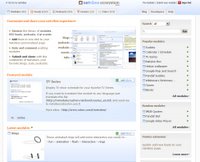
And this brings us to the Netvibes Ecosystem, which really is more than a fancy name for a bunch of feeds. The Ecosystem consists of modules, feeds, podcasts, events and tabs. We've explained what tabs are, and you probably know what feeds and podcasts are. Modules are advanced little programs which can do almost anything - from showing the weather to displaying your bookmarks. Events are little calendar apps which show certain dates - basically, they're public Google calendars, but a nice thing to have. On top of all this, the Ecosystem is well organized, easy to browse and search, and from it you can add modules to your page with a single click.

6. Filtering


One of the new Netvibes features is filtering. It works simple - you have a little text box on the top of your screen. Type a keyword, and all modules not containing the keyword will shrink, while those that do contain the word will have it highlighted. Nice, fast, and handy.

7. Digital Life Assistants

Recently the Netvibes crew created a couple of new, advanced modules called Digital Life Assistants. Basically, these are search modules but with many convenient options - for example, video search with full screen viewing. Find more about these here.

8. Keyboard controls

I don't personally use this (I find it hard to get used to keyboard shortcuts in general), but it might be handy for some users.
For this to work you need to enable it in Settings. Your focus also must be in the right place - click somewhere inside the Netvibes window before using keyboard shortcuts. You can find the list of all available shortcuts here.


9. Calendar
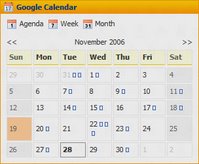
This calendar module is just one module, but it's so much better done for Netvibes than the Gcal for Google. It has several views and generally looks much nicer, as you can see in the picture. It also supports everything in iCal format.


10. Name for your page

Not really a dealbreaker, but it's nice to be able to see TechShrine or something cool like that above your page (it also appears in the page title). You guessed it - Netvibes can do it, Google can't.

*By the way, if you're interested in an alternative to Netvibes, you can always try Pageflakes, also a very nice service of the same kind.

Labels: , ,


Read entire post! | Digg! | Reddit! | del.icio.us! | Stumble!

0 comments | Monday, November 27, 2006

Notice: You are viewing a post on my old site. Click here to go to the new site.

What, the good old traditional tube is slowly dying because of Youtube and similar services? Don't worry, TV execs, I'm sure the dinosaurs also gave a good fight before they became extinct

It really doesn't come as a suprise that a Great Britain study shows that 20% of users watch a lot less traditional TV because they spend their time watching mobile and online video, and additional 23% say that they watch a bit less normal TV for the same reason.

This is because old-fashioned TV is boring, folks. And it keeps hammering commercials in your brain at least 10% of the time. On YouTube and similar services, I can watch what I want, when I want it. God help the traditional TV and media houses when online video quality improves.

Full results of the study here.

Labels: , ,


Read entire post! | Digg! | Reddit! | del.icio.us! | Stumble!

2 comments | Friday, November 24, 2006

Notice: You are viewing a post on my old site. Click here to go to the new site.

Unique hits and other statistics are often seen for websites, however I was interested in how many unique hits does the Internet get every day. That's right: how many people connect to any web site daily.

This turned out to be a trickier question that I imagined. After an hour of Googling, I was able to find out what are the Internet usage stats per country, how fast do servers respond in various parts of the world, and even (though this data is pretty old) how much data the entire Internet contains.

The closest I got to the answer was at the sites of the big analysts - Nielsen/Netratings and comScore, which has the approximation of world internet usage of people over 15 years of age (why the age restricion, I don't know - I guess they're marketing oriented so they're interested in buying power more than anything else).

This number, cited from comScore's site, which I reckon represents the number of people who use the internet regularly, is 712,976,000. Yes, that's a big number, but it's not exactly what I was looking for. Besides, www.internetworldstats.com says the number is 1,086,250,903. On the other hand, Nielsen/Netratings seems to be more conservative, citing their "Current Digital Media Universe Estimate" at 482,821,770.

What I (mostly) don't know is the methodology behind this data - do these people use the internet daily, once every week, or, for example, once every month?
Things get more complex if you want to count the unique hits the internet gets, because one person can connect, disconnect and reconnect several times per day, and every time they do that it would technically be a unique visit. To complicate matters further, it would be interesting to know the sum of daily unique hits on all websites in existence.

However, with the help of this little chart, I can at least approximate these numbers.

Bear in mind that I used data from different sources, obtained with different methodologies and from different samples, and I did some huge simplifications to make my life easier. The numbers in this final paragraph are very rough and possibly very wrong.

So, if the average person has approximately 33 internet sessions per month, that would mean approx. 1.1 every day, which would mean that the internet gets somewhere between 531,103,947, 784,273,600 and 1,194,875,993 visits every day, depending on whose numbers you trust.

According to Nielsen/Netratings, an average person visits 1446 websites per month. (1446/30) = 48.2*482,821,770= 23,272,009,314 (if you trust Nielsen/Netratings) or 48.2*
1,086,250,903 = 52,357,293,525. (if you trust internetworldstats.com). This is the number of webpages visited daily.

Looking at these numbers I can't help the feeling that I might have screwed them up for a billion or two. Looking forward to constructive criticism (;.


Labels: , ,


Read entire post! | Digg! | Reddit! | del.icio.us! | Stumble!